
The Science Behind Creative Team Building Activities
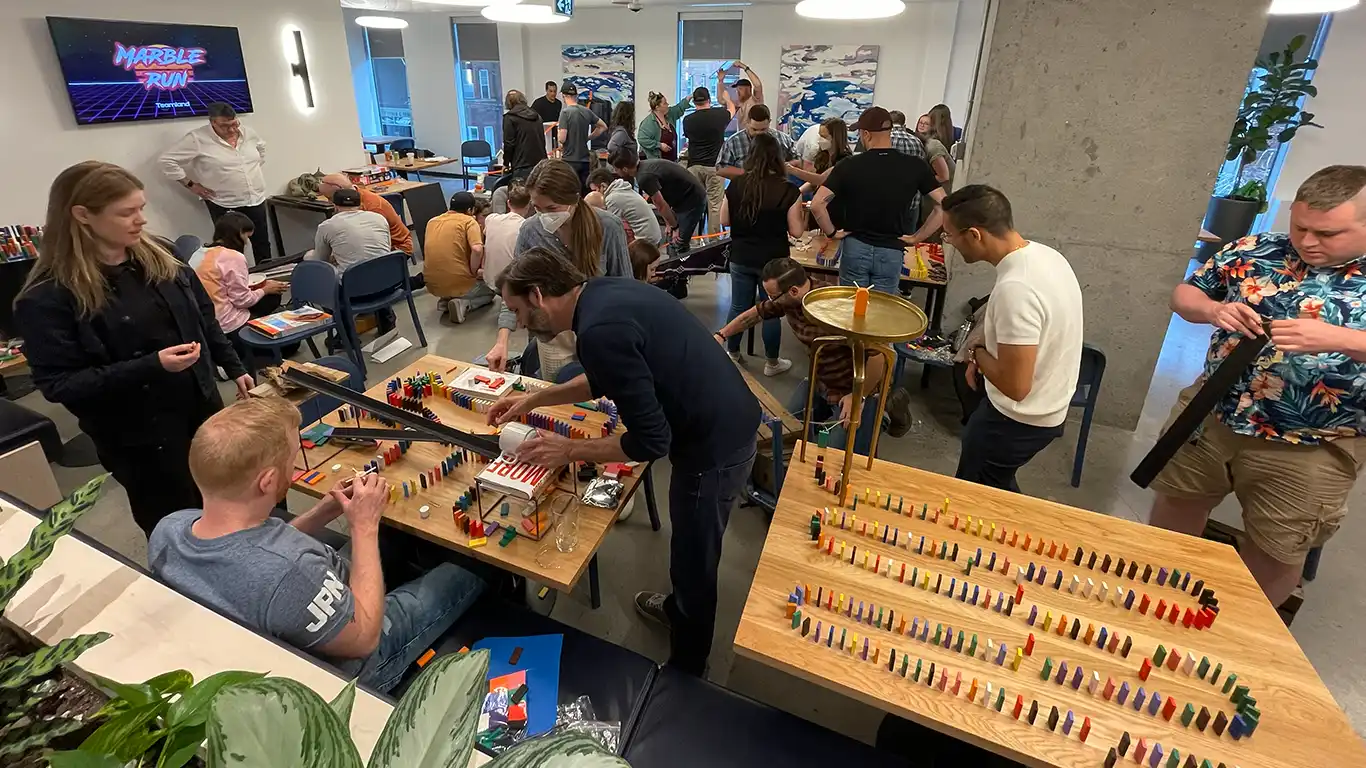
Research shows hands-on creative challenges boost collaboration and problem-solving. Here's why activities like Marble Run work.
Why do creative, hands-on team building activities work so effectively? Beyond the fun, there's solid science explaining why building marble runs, creating art, or tackling creative challenges produces better team collaboration than traditional corporate training.
The Psychology of Making Things Together
Reduced Social Barriers
Research in social psychology shows that working on physical tasks together reduces social barriers faster than conversation alone. When teams build something with their hands, several mechanisms activate:
Flow State and Team Bonding
Psychologist Mihaly Csikszentmihalyi's concept of "flow" - complete absorption in an activity - typically applies to individuals. But research shows teams can achieve collective flow states.
Creative team challenges create conditions for group flow:
- Clear goals: Build the longest marble run
- Immediate feedback: Test and iterate quickly
- Balance of challenge and skill: Difficult enough to engage, achievable enough to motivate
- Sense of control: Teams make their own decisions
When teams achieve flow together, they form strong positive associations with each other and the shared experience.
Creativity and Problem-Solving Transfer
Divergent Thinking Practice
Creative team building exercises divergent thinking - generating multiple possible solutions. Unlike convergent thinking (finding the one right answer), divergent thinking requires:
- Withholding judgment
- Building on others' ideas
- Considering unusual approaches
- Embracing failure as learning
These skills transfer directly to workplace problem-solving. Teams that practice divergent thinking in creative challenges apply it to business challenges afterward.
Psychological Safety
Harvard researcher Amy Edmondson's work on psychological safety shows that teams perform better when members feel comfortable taking interpersonal risks.
Creative team building builds psychological safety because:
When teams experience psychological safety in low-stakes activities, they bring that safety back to high-stakes work discussions.
The Neuroscience of Hands-On Learning
Embodied Cognition
Recent neuroscience research reveals that abstract thinking and physical experience are more connected than previously understood. This concept - embodied cognition - suggests we think with our bodies, not just our brains.
When teams physically build solutions:
Mirror Neurons and Empathy
Mirror neurons fire both when we perform an action and when we observe someone else performing it. This creates neural-level empathy.
During creative team building:
- Watching a teammate struggle and succeed activates similar brain patterns as experiencing it yourself
- Physical collaboration synchronizes team members' neural activity
- Shared effort creates genuine neurological bonds
Why Marble Run Building Works Specifically
Our Marble Run activity leverages all these principles effectively:
Multiple Intelligence Types
Howard Gardner's theory of multiple intelligences suggests people have different cognitive strengths. Marble Run building engages many:
Everyone contributes meaningfully regardless of their dominant intelligence.
Visible Collaboration
Unlike many work projects where individual contributions blur, Marble Run building makes collaboration visible:
- You see who generates ideas
- You observe who builds carefully
- You notice who encourages the team
- You appreciate who solves problems
This visibility helps team members understand each other's strengths beyond their job titles.
Safe Failure Environment
Engineering projects involve inevitable failures. Marble runs fall apart, marbles get stuck, designs don't work.
But these failures feel safe because:
- Stakes are low (no business impact)
- Time pressure is moderate (enough urgency to engage, not enough to panic)
- Iteration is expected and encouraged
- Humor emerges naturally from setbacks
Teams that learn to fail safely together approach workplace failures more constructively.
Applying the Research
Understanding the science helps you maximize team building value:
Before the Activity
During the Activity
After the Activity
The Research is Clear
Decades of social psychology, neuroscience, and organizational behavior research explain why creative team building works:
- Physical collaboration reduces social barriers
- Creative challenges teach transferable problem-solving skills
- Hands-on activities create stronger memories and bonds
- Psychological safety developed in low-stakes activities transfers to high-stakes work
The next time someone questions whether team building is worth the investment, you can point to the science. Creative collaboration isn't just fun - it's neurologically, psychologically, and socially effective for building better teams.
Ready to Experience the Science in Action?
See for yourself why creative team building delivers lasting results:
Ready to move from ideas to action?
Find activities that bring these insights to life